Posts Tagged ‘mafiaa’

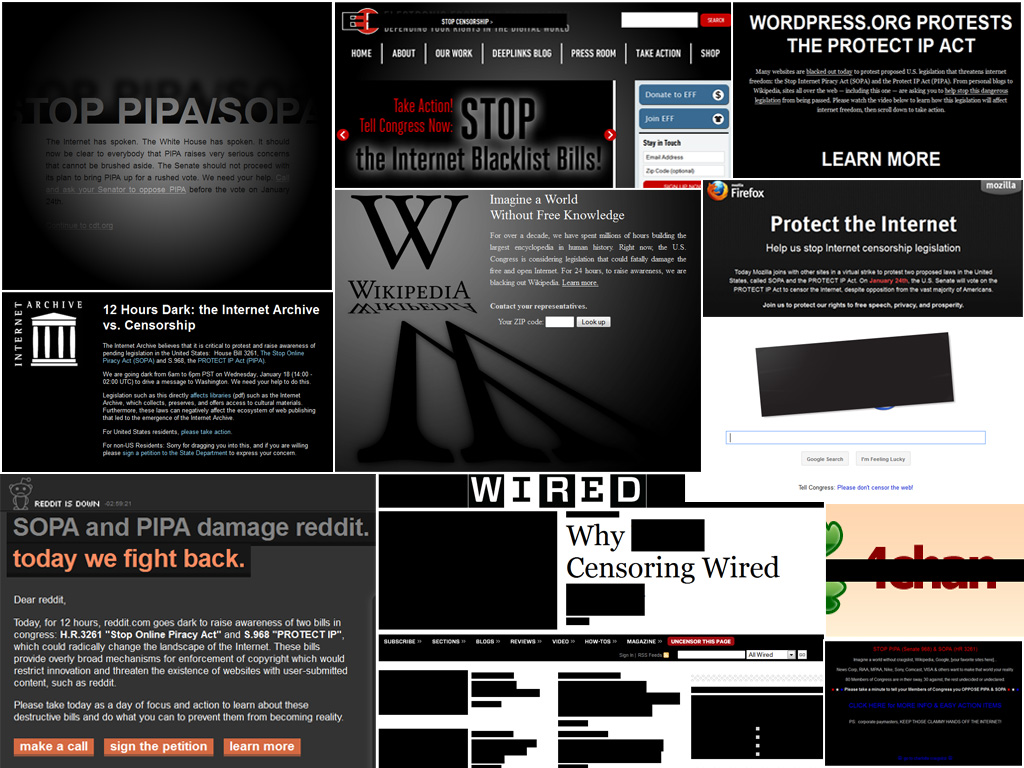
Collage I Made of the Front Page of a Few Major Websites Participating in the Web Blackout to Protest SOPA and PIPA Today. Pictured here is CDT, EFF, Wikipedia, WordPress, Mozilla, the Internet Archive, Google, 4chan, Wired, Craigslist and Reddit. http://sopastrike.com/

Click on the picture for full view.

22
Jun

Video and Download Link to Michael Moore’s New Film SICKO

   Posted by: AUDIOMIND   in Random

This new film is far less political than previous films and gives us a disturbing look into the dismal reality facing many ‘victims’ of the modern American health care system.
http://files.filefront.com//;7830973;;/

Click to download or view Michael Moore’s Film Sicko

And the best part is is that MM doesn’t care that this video is being shared, unlike the mafiaa studio hordes.

24
May

Spliced Disney Video(s) Used to Explain Copyright? WOW

   Posted by: AUDIOMIND   in Random

Below lies a pretty amazing (and somewhat obnoxious) video that recently surfaced which uses dozens of clips from Disney films to explain copyright law in many of its manifestations. Eric Faden of Bucknell University is the creator of a work that must have taken an insane amount of time to assemble. And what better way to explain copyright than to use objects from the very same corporation that abuses it the most?!?!
http://cyberlaw.stanford.edu/documentary-film-program/film/a-fair-y-use-tale
http://cyberlaw.stanford.edu.nyud.net:8080/biguploads/Fair(y)_Use_Tale_Stanford_Cut.mp4

A little background first…..

Kurt Hanson’s Radio Internet Newsletter has an analysis of the new royalty rates for Internet Radio announced by the US Copyright Office. The decision is likely to put most internet radio stations out of business by making the cost of broadcasting much higher than revenues.

Quote:

“The Copyright Royalty Board is rejecting all of the arguments made by Webcasters and instead adopting the ‘per play’ rate proposal put forth by SoundExchange (a digital music fee collection body created by the RIAA)…[The] math suggests that the royalty rate decision — for the performance alone, not even including composers’ royalties! — is in the in the ballpark of 100% or more of total revenues.”
http://www.kurthanson.com/archive/news/030207/index.shtml

—————————->>

A Forbes article discussing the dire news for fans of Internet radio. Yesterday afternoon saw online broadcasters, everyone from giants like Clear Channel and National Public Radio to small-fry internet concerns, arguing their case before the Copyright Royalty Board (CRB). The CRB’s March 2nd decision to increase the fees associated with online music broadcasting will have harsh repercussions for those who engage in the activity, the panel was told.

There was also a previous provision for smaller companies that allowed them to pay less, something the March 2 decision did away with; in the view of the royalty holders, advertising more than pays for these fees, and they’re ready for higher payments.

Quote:

“Under a previous arrangement, which expired at the end of 2005, broadcasters and online companies such as Yahoo Inc. and Time Warner Inc.’s AOL unit could pay royalties based on estimates of how many songs were played over a given period of time, or a ‘tuning hour,’ as opposed to counting every single song … [They] also asked the judges to clarify a $500 annual fee per broadcasting channel, saying that with some online companies offering many thousands of listening options, counting each one as a separate channel could lead to huge fees for online broadcasters.”
http://www.forbes.com/feeds/ap/2007/03/19/ap3531170.html

—————————>>

The Copyright Royalty Board formally rejects a request to reconsider its March decision to impose an onerous royalty schedule on Internet radio broadcasters.

Quote:

“None of the moving parties have [sic] made a sufficient showing of new evidence or clear error or manifest injustice that would warrant rehearing,” wrote the CRB in its decision.”

The recording industry (RIAA hordes) and its royalty collection organization SoundExchange are jubilant over the ruling, as you can imagine.

Quote:

“Our artists and labels look forward to working with the Internet radio industry, large and small, commercial and noncommercial, so that together we can ensure it succeeds as a place where great music is available to music lovers of all genres,” said SoundExchange head Simson in a statement.
http://arstechnica.com/news.ars/post/20070416-internet-radio-dealt-severe-blow-as-copyright-board-rejects-appeal.html

Noble words, but after today’s ruling, which will take effect on May 15 unless the US Court of Appeals for the District of Columbia Circuit agrees to hear an appeal, there probably won’t be much of an Internet radio industry left for SoundExchange to work with.

——————————>>

PLEASE HELP TO KEEP INTERNET RADIO ALIVE

This decision has the very real potential to force the closure of a wide realm of online webcasting sources that have significantly impacted the growth and development of independent roots music across all genres. To lose this avenue of promotion and support for roots based music could be potentially devastating with respect not only to its financial impact on the industry, but to its cultural survival.

http://www.musicdish.com/mag/?id=11693
http://www.petitiononline.com/SIR2007r/petition.html
http://www.saveourinternetradio.com/

Isn’t it past time that we burn the RIAA/MPAA houses down? ISN’T IT?!?!?

Record Store Owners Blame RIAA For Destroying Music Industry

DESPITE the major record labels’ best efforts to kill it, the single, according to recent reports, is back. Sort of.

You’ll still have a hard time finding vinyl 45s or their modern counterpart, CD singles, in record stores. For that matter, you’ll have a tough time finding record stores. Today’s single is an individual track downloaded online from legal sites like iTunes or eMusic, or the multiple illegal sites that cater to less scrupulous music lovers. The album, or collection of songs — the de facto way to buy pop music for the last 40 years — is suddenly looking old-fashioned. And the record store itself is going the way of the shoehorn.

This is a far cry from the musical landscape that existed when we opened an independent CD shop on the Upper West Side of Manhattan in 1993. At the time, we figured that as far as business ventures went, ours was relatively safe. People would always go to stores to buy music. Right? Of course, back then there were also only two ringtones to choose from — “riiiiinnng” and “ring-ring.”

Our intention was to offer a haven for all kinds of music lovers and obsessives, a shop that catered not only to the casual record buyer (“Do you have the new Sarah McLachlan and … uh … is there a Beatles greatest hits CD?”) but to the fan and oft-maligned serious collector (“Can you get the Japanese pressing of ‘Kinda Kinks’? I believe they used the rare mono mixes”). Fourteen years later, it’s clear just how wrong our assumptions were. Our little shop closed its doors at the end of 2005.

The sad thing is that CDs and downloads could have coexisted peacefully and profitably. The current state of affairs is largely the result of shortsightedness and boneheadedness by the major record labels and the Recording Industry Association of America, who managed to achieve the opposite of everything they wanted in trying to keep the music business prospering. The association is like a gardener who tried to rid his lawn of weeds and wound up killing the trees instead.

In the late ’90s, our business, and the music retail business in general, was booming. Enter Napster, the granddaddy of illegal download sites. How did the major record labels react? By continuing their campaign to eliminate the comparatively unprofitable CD single, raising list prices on album-length CDs to $18 or $19 and promoting artists like the Backstreet Boys and Britney Spears — whose strength was single songs, not albums. The result was a lot of unhappy customers, who blamed retailers like us for the dearth of singles and the high prices.

The recording industry association saw the threat that illegal downloads would pose to CD sales. But rather than working with Napster, it tried to sue the company out of existence — which was like thinking you’ve killed all the roaches in your apartment because you squashed the one you saw in the kitchen. More illegal download sites cropped up faster than the association’s lawyers could say “cease and desist.”

By 2002, it was clear that downloading was affecting music retail stores like ours. Our regulars weren’t coming in as often, and when they did, they weren’t buying as much. Our impulse-buy weekend customers were staying away altogether. And it wasn’t just the independent stores; even big chains like Tower and Musicland were struggling.

Something had to be done to save the record store, a place where hard-core music fans worked, shopped and kibitzed — and, not incidentally, kept the music business’s engine chugging in good times and in lean. Who but these loyalists was going to buy the umpteenth Elton John hits compilation that the major labels were foisting upon them?

But instead, those labels delivered the death blow to the record store as we know it by getting in bed with soulless chain stores like Best Buy and Wal-Mart. These “big boxes” were given exclusive tracks to put on new CDs and, to add insult to injury, they could sell them for less than our wholesale cost. They didn’t care if they didn’t make any money on CD sales. Because, ideally, the person who came in to get the new Eagles release with exclusive bonus material would also decide to pick up a high-speed blender that frappéed.

The jig was up. It didn’t matter that even a store as small as ours carried hundreds of titles you’d never see at Best Buy and was staffed by people who actually knew who Van Morrison was, or that Tower Records had the entire history of recorded music under one roof while Costco didn’t carry much more than the current hits. A year after our shop closed, Tower went out of business — something that would have been unthinkable just a few years earlier. The customers who had grudgingly come to trust our opinions made the move to online shopping or lost interest in buying music altogether. Some of the most loyal fans had been soured into denying themselves the music they loved.

Meanwhile, the recording industry association continues to give the impression that it’s doing something by occasionally threatening to sue college students who share their record collections online. But apart from scaring the dickens out of a few dozen kids, that’s just an amusing sideshow. They’re not fighting a war any more than the folks who put on Civil War regalia and re-enact the Battle of Gettysburg are.

The major labels wanted to kill the single. Instead they killed the album. The association wanted to kill Napster. Instead it killed the compact disc. And today it’s not just record stores that are in trouble, but the labels themselves, now belatedly embracing the Internet revolution without having quite figured out how to make it pay.

At this point, it may be too late to win back disgruntled music lovers no matter what they do. As one music industry lawyer, Ken Hertz, said recently, “The consumer’s conscience, which is all we had left, that’s gone, too.”

It’s tempting for us to gloat. By worrying more about quarterly profits than the bigger picture, by protecting their short-term interests without thinking about how to survive and prosper in the long run, record-industry bigwigs have got what was coming to them. It’s a disaster they brought upon themselves.

We would be gloating, but for the fact that the occupation we planned on spending our working lives at is rapidly becoming obsolete. And that loss hits us hard — not just as music retailers, but as music fans.

***********

What the music industry should have done is realized that the individual “value” of their product was going down and reduced their prices accordingly to compete. That is what the rest of the competitive enterprising world does. They didnt, because they forgot that they were serving the customer music…….not the gatekeeper of music.. Those days are over…

The internet is not your competitor.

The market changed. There’s no guarantee that says people with middleman jobs (those persons that try to add value by standing between the producer of a good or service and the consumer of that good or service) will have a job forever, even if it seems likely to them. Markets change. People change. For many reasons, some of them you may be in sympathy with, some of them not.

Further, there’s no law chiseled in stone that proclaims a musician’s right to live off album sales. Musicians historically have lived by the largesse of wealthy patrons. Selling sheet music, performances, and recordings yield a certain level of income but for the average musician who is not a star, it needs to be supplemented by teaching, whoring (i.e., playing for weddings/birthdays/after-parties), building and repairing instruments, or a part or full-time job washing dishes, working at a music store, etc.

There’s also no law that says a CD which cost about $0.50 to stamp out has to sell for $15. Cut the prices back to $5 or $8 per disk and you’ll see sales shoot right up. Record albums used to sell for $4 or $5 back in the day, then tapes came along and bumped the price up to about $10 or $12, and then CDs went through the roof. OK already, if a CD *player* now costs around $20 why are disks still so damn expensive?

The amount of money musicians see from a CD sale is vanishing, especially when a middleman has done the production, mastering or promotion work. Do you honestly believe that out of that $15 (or $12 or $18 or….) the musician will be receiving more than $0.25 or $0.50 per copy? Typically not. If you self-produce, as less well-known musicians are forced to do, you’ll have to front about $20,000 in studio time, design, copying and printing expenses, and it takes a long time to make that kind of money back from sales, let alone start to turn a profit. Disks are really a calling card, a way of getting your name out there and popularizing your music rather than some kind of bread-and-butter solid income the RIAA (mafiaa) makes it out to be. Sure, a nationally known act with a dozen recordings out is going to be making some income from record sales but the lion’s share is still going to middlemen.

Because of this situation, I think it makes more sense to simply upload your music and get the public listening to it, then ask these same people to pay to hear you play live. People have long demonstrated that they will pay for great music either live or recorded. There were people making thousands of dollars a month on mp3.com, though most of the musicians there were amateurs. Yet, mp3.com had an interesting business model and I’m very sorry it got bought out.

The RIAA is living in a time warp. It’s no longer possible to monopolize sound waves. Even twenty-five years ago, we became used to constantly taping each other’s records, albums, tapes and even music on the radio. No one was rich enough or crazy enough to purchase every single must-have album out there, even though we all wanted to. So now that we have a much better music delivery system that very quickly distributes music out to millions of people all over the world–let’s take advantage of it and the money will follow. Apple, CDBaby, mp3.com–were thinking creatively and sooner or later a business model will emerge that leverages the current technology and gives musicians back some remuneration for their efforts.

Music isn’t dead, and it isn’t going to die. Let’s face it – as musicians, as listeners – the producers and consumers – we’re going to be fine. As musicians, maybe we’ll have to move to a different distribution model, and maybe it’ll be different as to how one moves to the top of the heap. It’ll still depend on your music to some degree (too bad it isn’t 100%), though…..maybe moreso. As consumers, maybe we’ll have to enhance our searching skills to find stuff we like. Surely the radio hasn’t been a good source for anything but the crassest pop and bottomfeeder “repeat it until it sucks” marketing mechanisms for years….so personally, I look forward to changes in the musical landscape. As for the middlemen, things change. Maybe you’ll have to close your music studio or record store. No sign of that yet for some, but OTOH, you can buy mixing and recording equipment for a fraction of what it used to cost, a rack-mount mastering unit that can really do a very good job……but all in all there are no guarantees for the middleman. Not in music, not in written material, and certainly not in video. If you find a niche and you can make it work, my hat is off to you. If it stops working though, it is you that needs to change – because sniveling about how you thought you’d be able to “spend your life” doing something ‘great’, is just a bit pathetic.

1
Mar

RIAA Announces New Campus Lawsuit Strategy – EXTORTION

   Posted by: AUDIOMIND   in Random

in response to this story……:

http://www.slyck.com/story1422.html

“…………

Many people have become familiar with the mechanics of the RIAA lawsuit engine. One of the agents of the RIAA, such as Media Sentry, downloads a file from an unsuspecting file-sharer. A screenshot is made of the individual’s shared directory, or several files are downloaded to ensure a viable case. The individual’s IP address is then obtained. The RIAA then subpoenas the file-sharer’s ISP requesting the personal information associated with that IP address when the alleged upload occurred. The RIAA then informs the unsuspecting file-sharer of an impending lawsuit, but also gives the option to settle. A typical settlement costs between $3,000 and $5,000 US.

…………..

The new RIAA plan implements a device called a “pre-lawsuit letter”. The plan is currently underway, as the RIAA has already sent 400 of these letters to various college campuses. Basically, the letter is sent to the collegeor university, and is then forwarded to the student. Instead of threatening a lawsuit outrightly, within 20 days the student has the option to settle at a “discount”. The RIAA would not elaborate on how much this discount was. We can only speculate that it is less than the current financial lawsuit threshold of $3,000.”

i give you a song…..


Buddy you’re a boy, make a big noise
Playing music in school, gonna be a big man some day
You got music on myspace
You big disgrace
Kickin your ipod all over the place

We will, we will, sue you

Buddy you’re a young man, pirate man
Shoutin’ in the school gonna take on the MAFIAA some day
You got music on myspace
You big disgrace
Wavin’ your napster all over the place

We will, we will, sue you

Buddy you’re an old man, poor man
Pleadin’ with our lawyers gonna make you pay today

You lost your court case
You big disgrace
The MAFIAA kicked you off of myspace

We will, we will, sue you

Page 1 of 11